2 Design Pressures
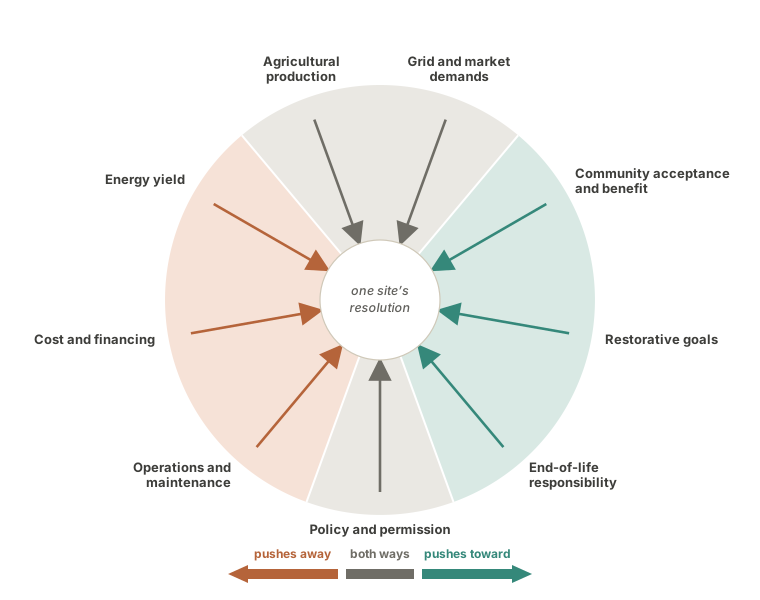
The developer, neighbor, farmer, buyer, and county do not want the same thing from a solar project. The developer needs a simple rectangle it can build at the price it bid. The farmer needs clearance for a tractor and a lease that runs as long as the array. The neighbor wants a screen along the road, the buyer wants the credits its scorecard counts, and the county wants the tax revenue and its own setbacks observed. Every project settles those claims, and mostly settles them without anyone saying so: the seed mix goes to turf, or the permit stalls. These are the pressures: nine forces, each with a direction and an advocate. Naming them makes the disagreement arguable, and says who is carrying what the design could not settle.
2.1 The pressures
Nine forces act on every site. Three push toward restoration, three push away, and the direction of the remaining three is settled by the site, the buyer, or the county. Restorative goals is the one this lexicon exists to advance, and it is still a force among forces rather than a score to hold a project against. The third column is the one worth arguing about, because it is where a project’s restorative claim is won or lost. Two pressures can point the same way and still collide, which is what makes the reversibility argument in §2.2 the hard one.
| Pressure | What it asks for | Push on restoration |
|---|---|---|
| Restorative goals | Wider rows, mixed ground cover, a plan covering all thirty years, and choices made for the sake of what grows underneath (Hernandez et al. 2019) | Toward. The one this document argues for. It still loses to the other eight most of the time |
| Community acceptance and benefit | Two things, and a design needs both. Process: engagement early enough that the answer can still change the design. Receipts: what the project pays back — tax revenue, agreements, subscriptions, local hiring, part-ownership | Toward, mostly. A township that gets a real say usually asks for more than a check. It can also ask for mown grass and a taller fence. And paying people without asking them first buys resentment, not consent (Crawford et al. 2022; Ryder et al. 2023) |
| End-of-life responsibility | Removable foundations, less digging, funded decommissioning, ground that can go back to what it was | Toward. Every trench and every graded acre is soil somebody has to rebuild later. The cheapest decommissioning is the one designed on day one, and the bond is what keeps the cost off the county |
| Agricultural production | Clearance for a tractor, room to turn at the end of a row, something worth growing underneath, and a contract the farmer can work within for the project’s whole life | Both. It is why there are sheep under the panels. It is also why there is no prairie under them: ground that has to grow something salable cannot also be left alone |
| Grid and market demands | Whatever the buyer and the grid require: the power contract, the renewable-energy credits, the tax benefits, an interconnection the queue will actually deliver | Both. When a buyer’s scorecard rewards pollinator habitat, habitat gets planted on a thousand sites at once. When that scorecard was written for a different climate, the wrong seed mix is in the contract for twenty years |
| Policy and permission | Whatever the rules require before the project can happen at all: the permitting path, prime-farmland and setback rules, state programs, and the subsidies that decide what pays | Both. In California, groundwater law pays a grower to retire irrigated ground. In Iowa, the ethanol mandate pays a grower to keep planting it. Same pressure, opposite instruction, and the state line decides |
| Operations and maintenance | Cover that is simple to mow, or gravel that does not grow at all, for twenty-five to forty years | Away, then toward. Somebody mows that ground for the next thirty years. Gravel never needs mowing, which is how gravel wins. Natives cost more for three years and less every year after, so which way this pushes depends on how far ahead the owner is looking |
| Energy yield | Panels packed close, tilted and turned to follow the sun, mounted low, covering the whole field | Away. This is why the standard array looks the way it does: low, tight, edge to edge. Not always opposed, though. Plants under the panels hold the dust down and keep the modules cool, and cool modules make more power (Merheb et al. 2025) |
| Cost and financing | Standard racking, low mounting, no special site preparation, simple rectangles instead of awkward shapes · a project big enough, and an offtaker sound enough, to raise the money against | Away, twice over. Anything unusual costs more and somebody will ask why it is worth it. And the paperwork does not scale down, so the middle of the transect pays a premium per watt for reasons that have nothing to do with how it was built. Sometimes the answer is cheap: siting New York’s entire 2050 build around biodiversity came to 0.17% more than the cheapest version (Gallaher et al. 2026) |
A site nobody will finance does not get built, and none of the nine can simply be argued away.
2.2 Where the pressures collide
What a given design leaves unresolved is its design tension. No setting of the levers reduces it to nothing, because the nine cannot all be satisfied at once and a project has to be built anyway. What varies is how much is left, and which parties are carrying it: a design can be quiet because the pressures genuinely accommodated each other, or quiet because one party gave up and went home. The settings that leave the least tension are the ones that get built repeatedly, which is where the archetypal forms come from.
Agricultural production vs. restorative goals. Should the ground under the panels grow food, or habitat? This is the American Farmland Trust / ecovoltaics argument. Requiring crops rules out pollinator plantings; choosing habitat gives up the farmland-protection case. Both sides are defending something real, which is why treating it as a misuse of words settles nothing.
Operations and maintenance vs. everything. Gravel and herbicide are easy; diverse perennial cover is not. The maintenance bill decides many restorative designs.
Grid and market demands vs. restorative goals. Buyers and scorecards can spread good ground-layer practice, but a rule written at a distance can also lock in a poor local fit for the term of a contract (Electric Power Research Institute 2021).
Energy yield vs. restorative goals. Clearance, spacing, and crop shade tolerance interact. Vegetation can also cool modules, reduce dust, and lower panel-washing demand, so the two pressures occasionally align (Merheb et al. 2025).
Cost and financing vs. operations and maintenance. Often mistaken for a single pressure. They split on what to plant, how high to mount, and how to get equipment in: cheap to build is frequently expensive to keep.
End-of-life responsibility vs. restorative goals. The hard one, because both pressures push toward restoration and still collide. Established habitat and rebuilt soil take years to create and resist clean removal: a project designed to disappear cleanly and a project designed to heal the ground are not always the same project.
Community acceptance and benefit vs. cost and financing. Community benefit costs money but cannot substitute for fair process. Its cost should be calculated, not assumed: a biodiversity-conscious New York portfolio was only 0.17% above the least-cost case, although farmland preservation made other tradeoffs (Gallaher et al. 2026).
2.3 The same pressures, weighted by place
The nine act on every site and carry different weight in every region. Shade that relieves a water-stressed crop in Arizona can cut maize yield in Ohio, and retirement above a depleted aquifer has no equivalent in a rain-fed county. The vocabulary travels; the weights do not. That is why this lexicon argues an aim and leaves the dimensions to the site.
Six factors that shift the weights
| Factor | What it changes |
|---|---|
| Resource: sun and cloud | Cloudier regions carry a higher diffuse share, which reaches under and between panels more readily than direct beam and gives a ground layer a more forgiving floor. Strong beam raises the value of tracking and the opportunity cost of clearance and wide rows |
| Grid operator | The grid market often fixes how big a project will be before the land does. Queue delays and curtailment cut the value of the marginal megawatt and soften the push toward dense geometry. Where no community-solar program exists, projects skip the middle sizes entirely and lose the range where the most design choices stay open |
| Aridity | Reverses the value of shade. Water-limited, high-radiation settings can trade light for relief; humid and temperate ones lose yield without a compensating saving, with the turn near 30 °C ambient across 367 paired observations (Merheb et al. 2025). Hydrologic work shifts from demand relief to interception |
| Latitude | Sets sun angle, tilt, row spacing, and therefore ground coverage. Wider northern rows give the ground layer more light and use more land; tighter southern arrays do the reverse. The resulting pore space is why vertical bifacial primary agriculture (S1) is not equally viable nationwide |
| Cropping system | Decides whether keeping a crop under the panels is plausible at all. Leafy and root horticulture and many forage grasses tolerate moderate shade; C4 grains and many fruiting crops do not, so a maize and soybean region leans on grazing and on leases rather than on cropping through |
| Irrigation | Makes impaired-land siting possible where a district exceeds its aquifer budget, because retiring demand saves water and solar makes the retirement pay. Rain-fed regions have no consumptive use to retire, and their water work is interception instead |
A worked calibration: the United States
The table below is one calibration, offered as a worked example rather than a finding. Regions are drawn loosely on the USDA resource regions and named for recognizability, and the last column is what the factors, taken together, tend to push a region toward.
| Region | Resource & light | Water | Cropping | Market | Tends toward |
|---|---|---|---|---|---|
| Desert Southwest | Highest GHI, low diffuse, strong beam | Arid; groundwater-limited | Irrigated specialty, rangeland | CAISO / WECC, large-scale | Shade as a benefit; cropping continues under the panels where irrigated horticulture persists, and irrigation is retired where water is the binding constraint |
| Central Valley & irrigated West | High GHI | Arid, and governed under SGMA | High-value specialty, heavily irrigated | CAISO, strong offtake | Retiring irrigated ground at scale; retired-irrigation solar |
| High Plains | High GHI, high latitude spread | Ogallala overdraft; declining wells | Grain, cotton, beef | SPP / ERCOT, curtailment risk | Retiring irrigated ground where the aquifer binds; grazing on the large arrays |
| Corn Belt | Moderate GHI, moderate diffuse | Rain-fed; runoff and nutrient export | C4 grain, soybean | MISO / PJM, deep queues | Leases and grazing; hydrologic function as interception, via prairie strips and pollinator ground layers |
| Great Lakes & Northeast | Lowest GHI, highest diffuse fraction | Humid; drainage, not scarcity | Dairy, forage, vegetables | Community-solar programs, so mid-sized projects are real | Crops and stock kept on the ground at small and community scale; vegetable agrivoltaics, barnyard shelter |
| Southeast | Moderate-to-high GHI, humid and cloudy | Humid; rainfall intensity | Row crop, pasture, poultry | Largely non-ISO, utility-led | Grazing at scale, and leases with managed ground layers |
Read each row as a starting hypothesis, not an assignment. Counterexamples are worth reporting.
What follows
The pressures are constant but their weights are not. Designs should differ when resource, grid, crop, or water conditions differ. The characteristic failure is importing a resolution from another region, often through an offtake-conformity rule that travels farther than the evidence behind it.
What the array replaces is itself a regional fact, and it changes what a sparing argument even means. Nationally, cropland is the dominant thing US solar has displaced. In New York it is not: of utility-scale solar built to date, 48% displaced pasture and hay, 38% cultivated crops, and 11% forest (Gallaher et al. 2026). That puts forest conversion and grassland bird habitat at the center of a conversation that in Iowa would be about row crops and nutrient export. A position on the axis travels between regions; what sits on the other side of the decision does not.
This is why the document prescribes an aim rather than dimensions. Regional calibrations are especially useful contributions: the zone bands are indicative for the US Midwest, and a region with different bands, missing zones, or a different binding constraint extends the lexicon.